
Albania’s Ancient Voice Is Now in a Hollywood Epic
When Christopher Nolan went looking for a sound older than history, he found it in Albania
This summer, something remarkable happened. Christopher Nolan released The Odyssey, one of the most anticipated films in years, a retelling of Homer’s ancient epic starring Matt Damon and shot entirely on IMAX cameras. And woven into its soundtrack, heard by audiences in cinemas across the world, is the sound of southern Albania.
For those of us who grew up with this culture, this moment feels like a long time coming. Albania has always carried something ancient and extraordinary inside it. And it moves us deeply to see the world beginning to discover it.
What is Albanian iso-polyphony?
Oscar-winning composer Ludwig Göransson, known for his work on Oppenheimer and Black Panther, traveled to southern Albania while creating the score for The Odyssey. Christopher Nolan did not want a conventional orchestral soundtrack. He wanted music that felt rooted in the Bronze Age, something that sounded as if it had always existed. Göransson found what he was looking for in Labëria.
Albanian iso-polyphony is one of the oldest living vocal traditions in the world. Recognized by UNESCO as an Intangible Cultural Heritage of Humanity, it is a style of multipart singing where several voices intertwine over a sustained drone, creating a sound that is at once ancient, haunting, and deeply human. Göransson spent a week recording this tradition in the Albanian south, along with the traditional shepherd flutes, instruments that have been played in these mountains for thousands of years.
The recordings had to finish before 6 p.m. each day, because the Albanian musicians rose at 4 a.m. to tend their flocks. Even the schedule of the recording tells you something about Albania: ancient rhythms, lived every day.
Why this matters to us
When Ramiz, the owner of Çka Ka Qëllu, decided to open this restaurant, it began with a question his son asked him: where could he take his friends for authentic Albanian food in New York? Ramiz searched, and came up empty. So he made it his mission to bring Albanian culture, in all its depth and beauty, to this city.
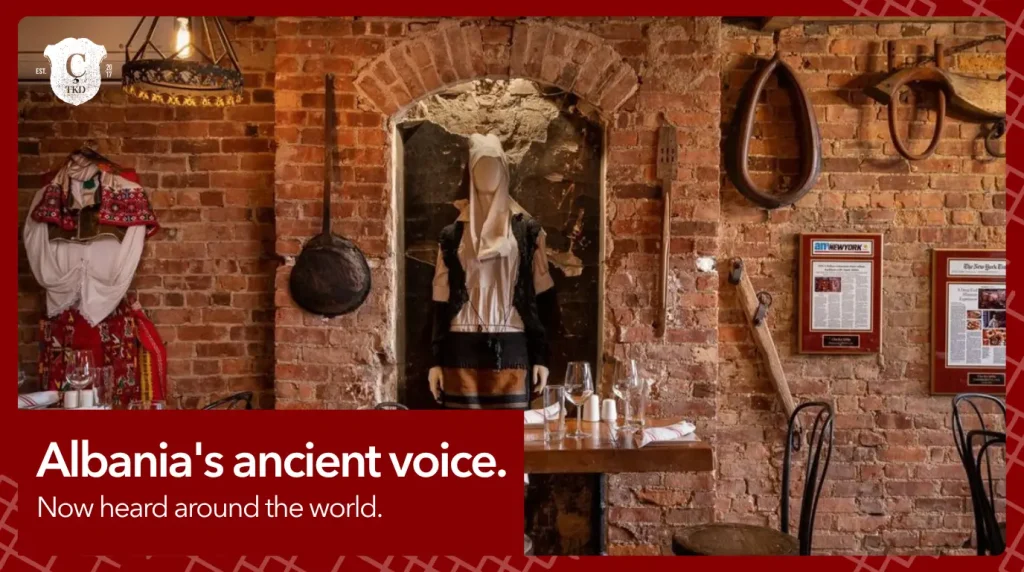
He spent years collecting 18th and 19th-century Albanian artifacts to fill the walls of the restaurant. Today, Çka Ka Qëllu is as much a museum as it is a dining room, a living tribute to a culture that has so much to offer the world and has too often been overlooked.
What Göransson heard in the hills of Labëria, what moved him enough to build a Hollywood epic around it, is the same culture that fills every corner of our restaurant. The same pride, the same depth, the same ancient story told in a different form. When Albania appears on the world stage, we feel it personally. This is exactly why we are here.
Come experience Albanian culture for yourself
You don’t need to travel to the hills of southern Albania to feel the depth of this culture. At Çka Ka Qëllu, we have spent years creating a space where Albanian history, art, food, and warmth meet at one table.
The same civilization that gave Hollywood its ancient sound has also given us cornbread baked with three cheeses, grilled octopus from the Ionian coast, lamb slow-raised in mountain air, and a table culture built on the belief that guests are a gift from God.
Come hear Albania for yourself. Not through a cinema speaker, but through a plate, a glass, and a table surrounded by a culture that has always deserved this kind of attention.
From the hills of Labëria to the cinemas of the world, Albania’s voice has never been more alive. Come sit at our table and feel it.
Albania has always had a table in America. You’ll find it at Çka Ka Qëllu.