

What Is Fli?
The time, technique and tradition behind Albania’s most distinctive layered dish
Some dishes are defined primarily by their ingredients. Fli is defined by the way it is made.
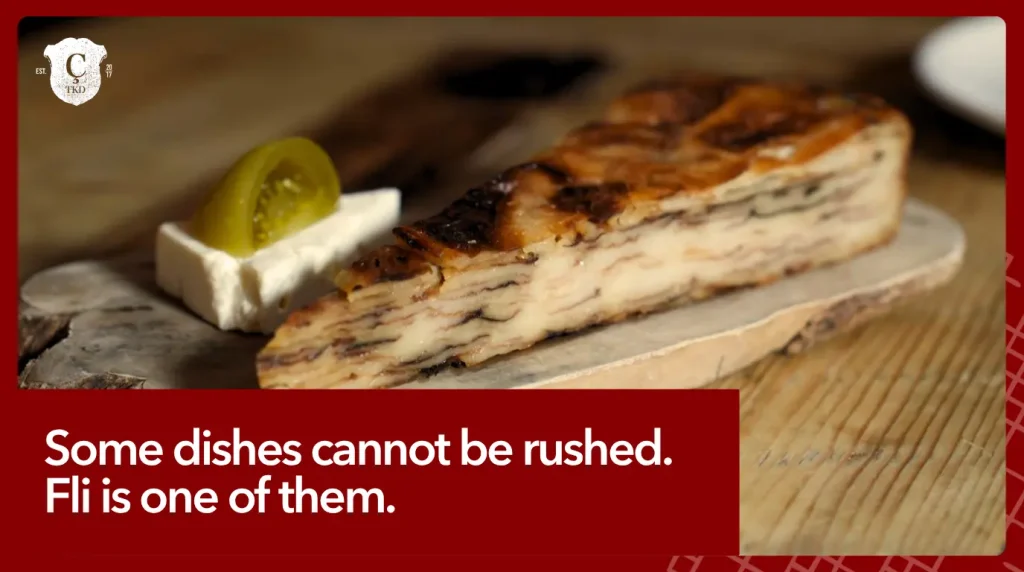
Flour, water, salt, butter and dairy form the foundation of this traditional Albanian dish. None of these ingredients is unusual on its own. What transforms them is a careful process in which thin layers of batter are added and baked one after another, each given the time it needs before the next begins.
The preparation can take hours. Each layer must be given enough time to set and develop colour before the next is added. The finished fli carries a visible record of that work, with delicate golden layers forming a soft, rich and lightly crisp structure that no shortcut can replicate.
It is one of the most honest expressions of how Albanian cooking can create something truly distinctive from a small number of carefully handled ingredients.
Where does fli come from?
Fli, also commonly written as flija, is especially associated with Kosovo and the northern regions of Albania. It developed within a rural food culture that relied on ingredients readily available in the household: flour, water, butter, cream and yoghurt. These ingredients could be combined without elaborate equipment, but preparing them properly required knowledge, patience and a feel for the heat that could only be learned over time.
Recipes were generally passed down through observation rather than written instructions. One generation prepared the dish while the next watched, helped with the fire, mixed the batter or brushed the layers. Over time, each household developed its own proportions and preferences.
Some versions are richer in butter. Others use cream, yoghurt or kajmak between the layers. The exact consistency and serving style may vary by family, by village, by memory, but the principle remains the same: fli is assembled slowly, through a repeated sequence of pouring, baking and brushing.
How traditional fli is prepared
The traditional process begins with a smooth batter made from flour, water and salt. A second mixture, usually containing butter and cream or yoghurt, is prepared for brushing between the layers.
The batter is applied to a large round pan in narrow sections, often creating a radiating pattern. The pan is then exposed to strong heat from above until the first sections begin to cook and turn golden. Traditionally, this heat comes from a saç, a large domed metal lid covered with hot embers, positioned over the pan to create an intense and controlled source of heat.
Once one layer is ready, the pan is uncovered, brushed with the butter or cream mixture and filled with another arrangement of batter. The process continues, layer by layer, for as long as the dish requires.
Rather than assembling the entire dish and baking it once, the cook must return to it for every individual layer. Heat must remain consistent, the batter must be spread evenly and the surface must be watched closely. This is why fli is difficult to describe simply as a pie, a bread or a pancake. It shares certain qualities with each of them, but its preparation gives it a category entirely its own.
Why the layers matter
The layers are not only visual. They determine how fli tastes and feels. The thin edges develop a light golden finish, while the butter and dairy keep the interior soft. Because the layers are baked separately, they remain distinct even after the dish is cut and served.
A properly prepared fli should feel substantial without becoming heavy or dense. The flavour is mild, buttery and slightly tangy when yoghurt or cultured cream is used, making it a wonderful companion alongside stronger dishes: roasted peppers, cheese, yoghurt or grilled meats.
A dish that requires time
Many traditional recipes can be adapted for speed. Fli resists that approach. Its character depends on repetition. A cook cannot produce several fully formed layers at once because each one needs direct contact with the heat before the next is added. The preparation time is not an inconvenience separate from the recipe. It is part of the recipe.
Historically, this also made fli a communal form of cooking. Maintaining the fire, preparing the mixtures and building the layers created work that could be shared. The long preparation allowed the kitchen, or the outdoor cooking area, to become a gathering place well before the meal ever reached the table.
That context explains why fli continues to carry importance beyond its ingredients. It represents accumulated knowledge and a style of cooking in which attention is given as much value as abundance. In many Albanian homes, it still does.
How fli differs from byrek
Fli and byrek are sometimes placed in the same general category because both are layered and prepared in a round pan. Their techniques, however, are very different.
Byrek is usually made with thin sheets of dough arranged around a filling such as cheese, spinach, meat or vegetables, then baked as an assembled whole. Fli is built from batter rather than sheets of pastry and has no conventional filling. Instead, butter, cream or yoghurt is brushed between layers that are cooked progressively.
Byrek is defined partly by what is placed inside it. Fli is defined by the layers themselves. Understanding this difference helps explain why fli holds such a distinctive place within Albanian cuisine. Its identity does not come from a filling or an accompaniment. It comes from the technique, and from the patience behind it.
Fli at Çka Ka Qëllu
At Çka Ka Qëllu, fli is one of the dishes we are most proud to share. It is made from delicate layers of hand-baked batter, brushed with rich butter to create a soft texture and golden finish. It can be enjoyed at the beginning of the meal, shared alongside other traditional plates or served as part of a wider exploration of Albanian and Kosovan food.
For guests who grew up with the dish, its appearance on the table can carry years of family memory. For those tasting it for the first time, it offers a clear and generous lesson in what Albanian cooking is about: simple ingredients do not produce simple food when time, knowledge and care are given their proper place.
Fli cannot be rushed, and it does not need to be reinvented. Its value is already present in every carefully prepared layer.
Discover fli at Çka Ka Qëllu in the Bronx, Manhattan, Stamford or Westwood. 🇦🇱